
The short version
Talinty is a hiring platform with AI layered through every step. It does what an applicant tracking system does (post jobs, collect applications, move candidates through a pipeline), and it goes further. Every candidate is scored against your criteria, the reasoning behind every score is laid out for you to read, and the AI gives you a clear recommendation by the time you're ready to make a decision.
If you've used an ATS before, the surface will feel familiar. The difference is what's happening underneath.
What it's actually solving
Resumes don't work the way they used to. Most candidates now write applications with AI. Most recruiters now filter with AI. The two sides have largely stopped reading each other, and the resume has become a marketing document written by one algorithm and read by another.
The data is consistent across studies: time-to-hire is up, candidate deception is up, and recruiters report increasing difficulty separating real signal from polished noise. Even with more AI in the pipeline than ever before, the experience of making a confident hire has gotten harder, not easier.
Talinty is built for the version of hiring that comes after that. Instead of trusting the resume alone, we pull in four independent signals and lay them next to each other.
The four signals
Resume fit: The classic match score, but tied to criteria you actually set. Instead of keyword counting, the model reads the resume against the role, weighting the things you said matter most. You see the score, and you can see why.
Verified skills: Talinty includes a library of 150+ skill assessments, in other words, the Question Bank, spanning a range of technical and soft skills. Results sit in the candidate profile, not on a separate tab in a separate tool. The point is to test what the resume claims, as part of the screening signal itself, not as a separate later step.
Structured reasoning: Every scored candidate gets a vetting brief broken into three columns: Why they match, Bonus strengths, Things to consider. It's not a summary of the resume. It's the case for and against the hire, written in the format you'd write it yourself if you had two more hours.
Behavioral signals: Async video interviews with AI transcription. You don't have to schedule a call to hear how a candidate talks about their work. You read or watch back, and you keep the recording in the profile for the rest of the team.
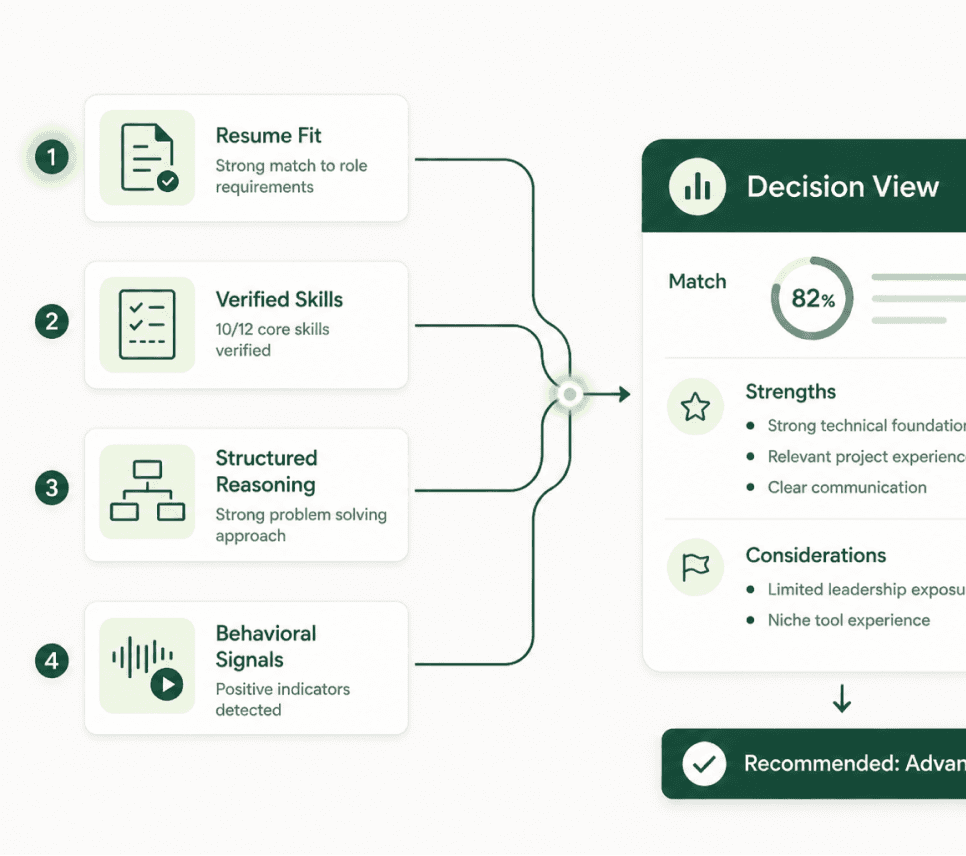
When those four signals agree, you have a defensible hire. When they disagree, Talinty shows you exactly where, and you decide what to do about it.
That is the core idea behind Talinty: hiring should not depend on a single document, a keyword match, or a vague sense of "good fit." It should be based on structured evidence.
What a week inside Talinty looks like
A concrete example. You're hiring a senior backend engineer.
Day one: you post the job. The AI drafts the description from a short brief you give it, you edit, you publish to your career page and LinkedIn. You're done with sourcing setup in about ten minutes.
By day three: 40 applications. Talinty has scored every one against the criteria you set and ranked the list. You open the top 10, read the three-column vetting briefs, and shortlist 5 for skill assessments. The bottom of the list isn't trash; it's just a different conversation for a different role.
Day five: 4 candidates have completed the assessment. You watch one async video interview, read the transcript of two others, and you compare candidates to put the top two side by side. The AI's recommendation is Advance for both, with different strengths called out.
Day six: you loop in the hiring manager with an @mention, share the tab with the shortlist, and route the approval.
Day seven, the offer goes out.
That's the shape. None of the steps are exotic. The win is that they all happened in one place, with the AI doing the first pass on each one, and a defensible trail behind every decision.
Who it's for, who it is not
Talinty fits teams that hire often and care about how the decision gets made. That's most commonly:
Recruiters and TA leads at scaling and mid-market companies.
HR teams hiring across MENA and Europe, particularly those who need Arabic right-to-left resume parsing.
Hiring managers who want to make decisions from structured evidence instead of impressions.
It's probably not the right tool if hiring is incidental to your role and you fill one or two positions a year. The AI engine is built for the volume problem; it earns its keep when there's a pool to sort.
What Talinty isn't
Talinty is a hiring platform, not an HRIS. Once you've made the offer, employee records, payroll, and ongoing HR live in your HR system. We integrate with most of them.
We're also not a job board. We distribute your roles to the boards you already use; we don't sell job-seeker traffic.
And we're not an AI sourcing crawler. Talinty works on the candidates who apply, the candidates you import, and the candidates you find through your CRM and referrals. It doesn't go out and scrape LinkedIn for you.
CONTINUE READING
Related articles
More ways to understand the product, the workflow, and the decisions behind Talinty.

| 3 Min Read
Creating your Talinty account
Sign up, verify your email, and set up your Talinty account in about five minutes.
Read article ->
| 3 Min Read
The onboarding wizard
A short setup flow that asks for the basics Talinty needs before you start hiring.
Read article ->

| 4 Min Read
Tour the Talinty dashboard
A walkthrough of the screen you'll spend most of your Talinty time in, and what each part is for.
Read article ->

| 4 Min Read
Navigate tabs and workspaces
Tabs let you look at the same role from different angles.
Read article ->

| 4 Min Read
Invite your first teammate
How to add someone to your Talinty workspace, what they'll see, and which role to give them.
Read article ->

| 4 Min Read
Anatomy of a candidate profile
Where everything about a candidate lives, and how to navigate the profile without getting lost.
Read article ->

| 4 Min Read
Review candidate AI insights
How to read the AI's view of a candidate, what each piece of it means, and when to trust it.
Read article ->
| 5 Min Read
Track candidate status and history
Where every action on a candidate is recorded, and how to read the trail.
Read article ->

| 3 Min Read
Add notes to a candidate profile
Where your team's judgment lives in the profile, alongside everything the AI sees.
Read article ->

| 4 Min Read
Move a candidate to another stage
How to move a candidate from one stage to another in simple terms.
Read article ->

| 4 Min Read
Disqualify or reject a candidate
How to end a candidate's journey in a way that's honest, recorded, and reversible if you need it to be.
Read article ->

| 3 Min Read
Invite and manage teammates
Add teammates to Talinty so they can collaborate on jobs, candidates, feedback, and hiring decisions.
Read article ->


Ready to hire with clarity instead of guessing?
Fifteen minutes. No commitment. A real walkthrough of Talinty in your context.
